
$25K–$250K Bail for Vehicular Manslaughter: What Families Can Do Fast

Bail for vehicular manslaughter typically runs from $25,000 to $100,000 for standard charges, and $100,000 to $250,000 or higher when alcohol, gross negligence, or serious injury is involved. Some outlier cases have topped $1 million. The exact number depends entirely on your county’s bail schedule and the judge assigned to the case, so the fastest way to reduce time in custody is to call a bail bonds company, like Armstrong Bail Bonds, or a criminal defense attorney within the first hour.
TL;DR:
- Bail for vehicular manslaughter generally ranges from $25,000 to over $250,000, with higher amounts for cases involving intoxication, gross negligence, or multiple victims.
- Judges can significantly adjust bail amounts based on specific case details, especially when severity, recklessness, or prior criminal history are present.
- Posting bail through a bondsman typically requires paying around 10% of the total bail, with rapid release possible within 30 minutes if all paperwork and fees are in order.
- Factors leading to higher bail include high blood alcohol content, reckless driving, flight risk, and evidence such as dashcam footage affecting case severity.
- Verifying county-specific bail schedules and acting promptly with a bail bonds company can notably reduce custody time after arrest.
Table of Contents
- How Much Is Bail for Vehicular Manslaughter?
- What Factors Push Bail Higher or Lower?
- How Long Does It Take to Post Bail After an Arrest?
- How Do Bail Bonds Work for Manslaughter Charges?
- What Conditions Come With Release in These Cases?
- The First 24 Hours: What Families Should Do Right Away
- Getting Fast Bail Help From Armstrong Bail Bonds
- Where to Verify Exact Bail Amounts in Your County
- Sources
- FAQ
How Much Is Bail for Vehicular Manslaughter?
The dollar figure attached to a vehicular manslaughter charge depends heavily on which statute prosecutors file under and which county the arrest happened in. County bail schedules set the starting point, and those numbers vary more than most people expect.
In Santa Clara County, gross vehicular manslaughter while intoxicated appears on the criminal bail schedule at amounts up to $250,000, while a standard vehicular manslaughter charge without the intoxication enhancement lists closer to $100,000. Los Angeles County’s felony bail schedule follows a similar pattern, with DUI-related gross negligence charges frequently landing near $100,000 and involuntary manslaughter entries ranging from $25,000 to $100,000 depending on the exact subsection charged. Riverside County’s bail schedule spreads even wider, listing vehicular manslaughter bail anywhere from $20,000 to $250,000.
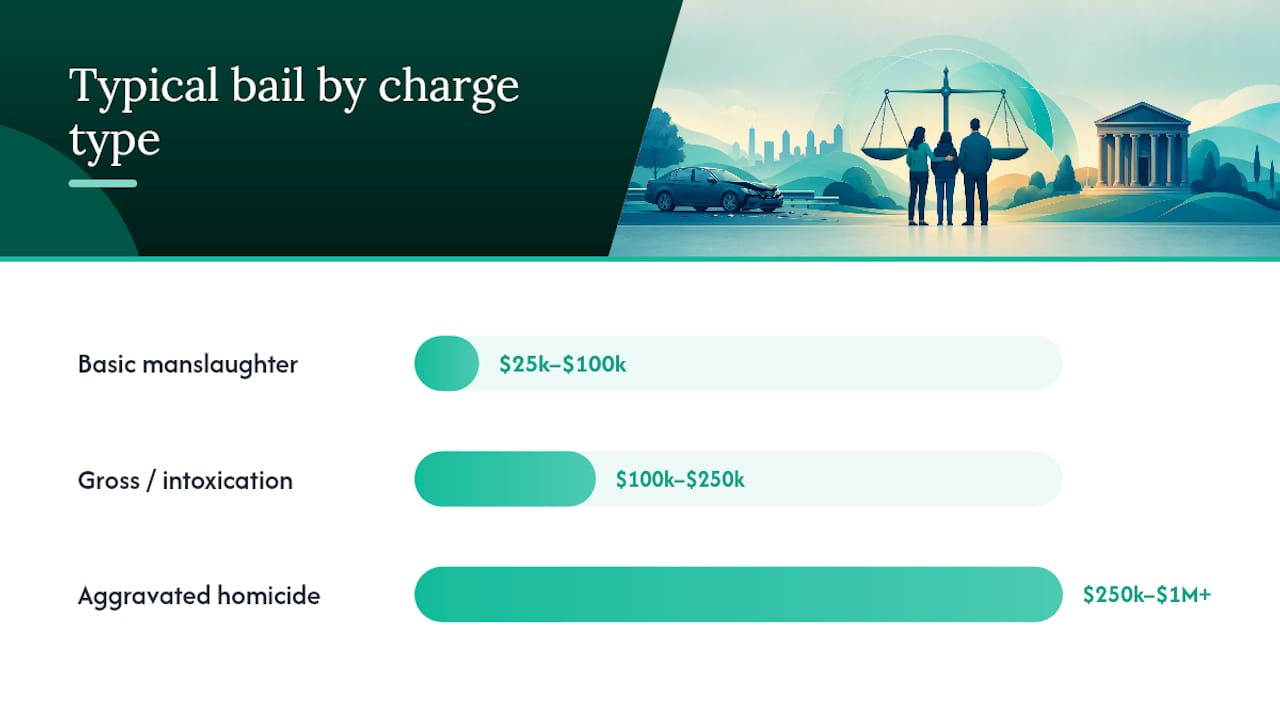
These figures are only starting points. Judges routinely deviate from them at arraignment, especially when the facts of the case are severe.
Common bail benchmarks by charge type:
- Basic vehicular manslaughter (no intoxication): roughly $25,000 to $100,000
- Gross vehicular manslaughter or intoxication-related: roughly $100,000 to $250,000
- Vehicular homicide with aggravating factors (extreme speed, prior record, multiple victims): $250,000 to $1 million or more
Statistic Callout: A 2025 case reported by The Columbian shows a judge setting bail at $1.5 million for a driver accused of striking a father and son. That number sits far above any county schedule’s default range, which tells you how much discretion judges hold once the facts get ugly.
News coverage from 2024 through 2026 shows a recurring pattern: intoxication paired with extreme conduct, like fleeing police or driving well over 100 mph, tends to push bail toward the high end or beyond, as seen in reporting from NBC Montana on a case involving multiple charges stacked onto a single crash.
What Factors Push Bail Higher or Lower?
Bail schedules give courts a number to start from, not a number they’re locked into. At arraignment, a judge can raise or lower that figure based on the specific facts in front of them, and vehicular manslaughter cases have several moving parts that swing the outcome hard in either direction.
The mental state prosecutors allege matters more than most defendants expect. Justia’s overview of vehicular homicide law notes that prosecutors often have to prove recklessness or gross negligence rather than simple negligence, and the higher that alleged culpability, the higher the bail tends to run because courts read it as a bigger public-safety risk.
Judges also weigh:
- Blood alcohol content or drug involvement at the time of the crash
- Speed and driving conduct, including eluding police or racing
- Prior criminal history, especially previous DUI or reckless driving convictions
- Flight risk, such as ties to another state or country
- Injuries to victims and whether the crash caused multiple deaths
- Pending charges elsewhere, which can trigger holds from other jurisdictions
Evidence quality shapes these allegations too. Dashcam or bodycam footage can make or break how prosecutors frame the case, which in turn affects what bail amount they push for at arraignment. You can read more about how bail is set and how these factors interact in practice.
How Long Does It Take to Post Bail After an Arrest?
Getting from arrest to release involves several fixed steps, and knowing them helps you avoid unnecessary delay. Here’s the typical sequence:
- Booking. The jail processes ID, fingerprints, and a mugshot. This usually takes two to six hours, longer on weekends or holidays.
- Bail review. Many jails apply the county’s bail schedule automatically during booking, before any judge even sees the case.
- Arraignment. The defendant appears before a judge, typically within 48 to 72 hours, where bail can be raised, lowered, or denied entirely.
- Posting bail or bond. Once an amount is set, cash bail or a bail bond can be posted immediately, sometimes before arraignment if the schedule amount is already known.
- Release processing. After payment clears, release usually happens within a few hours, though jail administrative backlogs, holds from other counties, or holiday staffing can stretch that out.
Paying the full cash amount takes time to gather. A bail bond, by contrast, only requires a fraction of that sum upfront, which is why most families choose that route when the number climbs into six figures.
How Do Bail Bonds Work for Manslaughter Charges?
A bail bond works by paying a bondsman a percentage of the total bail, typically around 10%, in exchange for the bonding company posting the full amount with the court. That premium is non-refundable. It’s the fee for the service, not a deposit.
Armstrong Bail Bonds has been operating in Southern California since 1926, and its stated process emphasizes online applications, flexible payment options, and relationships with local jails that support fast turnaround.
Bondsmen typically require:
- A signed application from a co-signer, usually a family member or friend
- Government-issued ID for the co-signer
- Proof of income or collateral, such as property or a vehicle title, for larger bail amounts
- The defendant’s booking number and facility location
Co-signers should understand they’re financially responsible for the full bail amount if the defendant fails to appear in court. That’s not a small commitment, and it’s worth reading through how bail bonds work before signing anything.
Pro Tip: When you call a bondsman, ask three things upfront: the exact premium percentage, what identification they need from you as the co-signer, and how soon they can physically be at the jail. A company that answers all three without hesitation is usually one that’s done this a lot.
What Conditions Come With Release in These Cases?
Release rarely means walking away free of restrictions, especially in a case involving a death. Courts often attach conditions designed to reduce risk while the case moves forward:
- Ignition interlock devices or transdermal alcohol monitoring for intoxication-related charges
- Passport surrender and travel restrictions
- Mandatory check-ins with a pretrial officer
- Electronic ankle monitoring in more serious cases
Statutory frameworks that govern these monitoring conditions exist specifically to reduce the odds of another incident before trial. Violating any condition can trigger immediate bail revocation and a return to custody. In cases involving special circumstances, prior violent felonies, or repeat DUI-related deaths, judges can deny bail entirely and order a no-bail hold.
The First 24 Hours: What Families Should Do Right Away
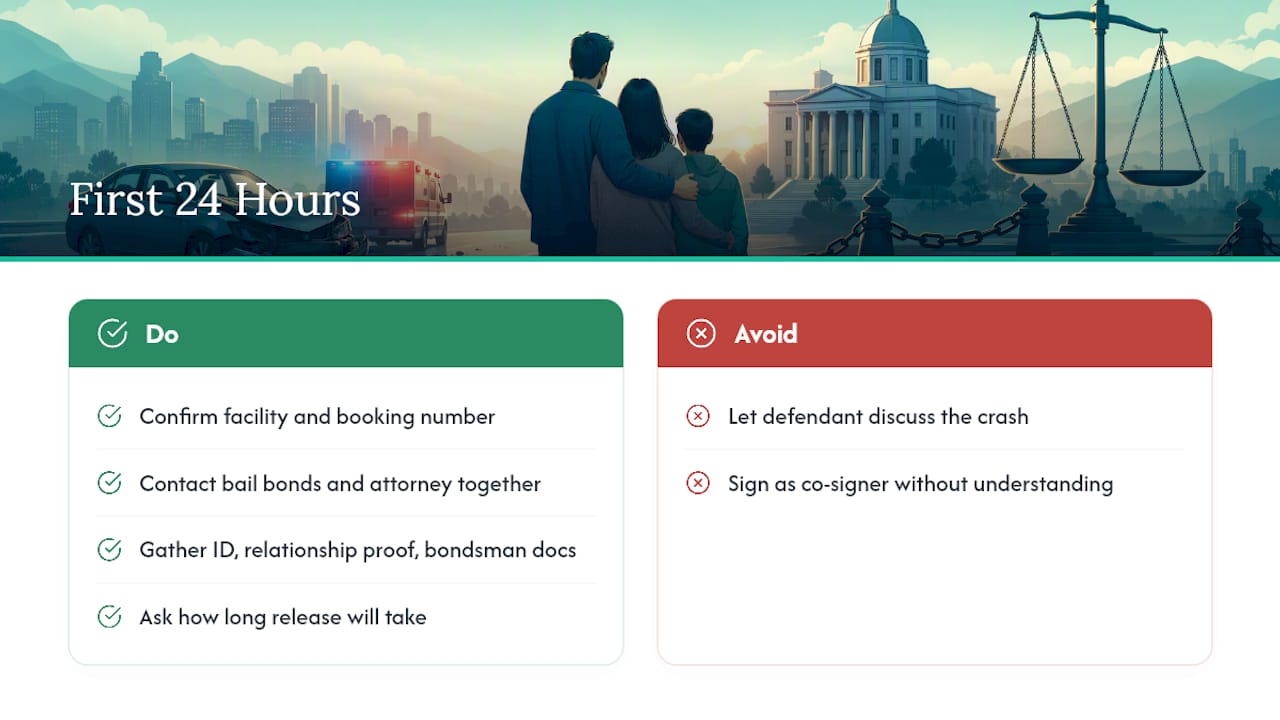
Confirm the exact facility and booking number before making any calls. Contact a bail bonds company and a criminal defense attorney at the same time, not one after the other. Gather your ID, proof of your relationship to the defendant, and whatever documentation the bondsman requests for payment.
Ask directly how long release will realistically take once funds transfer. Avoid letting the defendant discuss the crash with anyone, including cellmates, before speaking with a lawyer. And before signing as a co-signer, make sure you understand exactly what you’re financially responsible for if court dates get missed.
— Jake
Getting Fast Bail Help From Armstrong Bail Bonds
Waiting on a public defender callback or trying to scrape together full cash bail both cost you time you don’t have when a family member is sitting in a cell. Armstrong Bail Bonds has operated in Southern California since 1926, and its stated process points to rapid processing that can lead to release in as little as 30 minutes once paperwork and payment are in order.
The company offers an online application, flexible payment plans, bilingual English and Spanish support, and 24/7 availability, which matters when an arrest happens at 2 a.m. on a Saturday and county offices are closed. If you’re dealing with a vehicular manslaughter arrest anywhere in the Los Angeles or San Diego areas, start by reviewing what a bail bond actually is and how the process works, or go straight to the online bail bonds application to begin. Have the defendant’s full name, the facility name, and the booking number ready when you call. That single piece of information can shave real time off the release process.
Where to Verify Exact Bail Amounts in Your County
- Santa Clara County criminal bail schedule for Northern California figures
- Los Angeles Superior Court felony bail schedule for LA County amounts
- Riverside Superior Court bail schedule for Inland Empire figures
- County clerk offices remain the final word on any amount listed here, since schedules update periodically
This article is general information, not a substitute for advice from a qualified lawyer. Consult a qualified legal professional about your own circumstances before acting on anything here.
Sources
- Superior Court of the State of California - Santa Clara County criminal bail schedule (2025)
- Los Angeles Superior Court felony bail schedule
- Vehicular homicide overview — Justia
FAQ
What Is the Typical Jail Time for Vehicular Manslaughter?
Sentencing varies widely by state and the specific charge filed, ranging from probation for lower-level negligence cases to several years in state prison for gross vehicular manslaughter or cases involving intoxication and prior offenses.
How Much Does a $75,000 Bail Bond Cost?
At a standard 10% premium, the upfront cost of a bail bond depends on the total bail amount, though some bonding companies offer reduced promotional rates or payment plans for qualifying clients.
Can You Go to Jail for Accidentally Killing Someone in a Car Accident?
Yes. Most states, including Florida, allow prosecutors to charge vehicular manslaughter or vehicular homicide even when the death resulted from an accident, provided prosecutors can show negligence or recklessness rather than pure misfortune, as outlined in Justia’s overview of vehicular homicide law.
What Is Worse, Vehicular Manslaughter or Vehicular Homicide?
The terms overlap heavily and vary by state, but vehicular homicide charges generally apply when prosecutors allege a higher degree of recklessness or intoxication, which typically carries steeper penalties and higher bail than a standard vehicular manslaughter charge.
How Fast Can Armstrong Bail Bonds Get Someone Released?
Armstrong Bail Bonds states that its established relationships with local jails and its online application process can lead to release in as little as 30 minutes once fees and paperwork are complete, according to its published process description.