
How to Check Warrants in California: County Steps
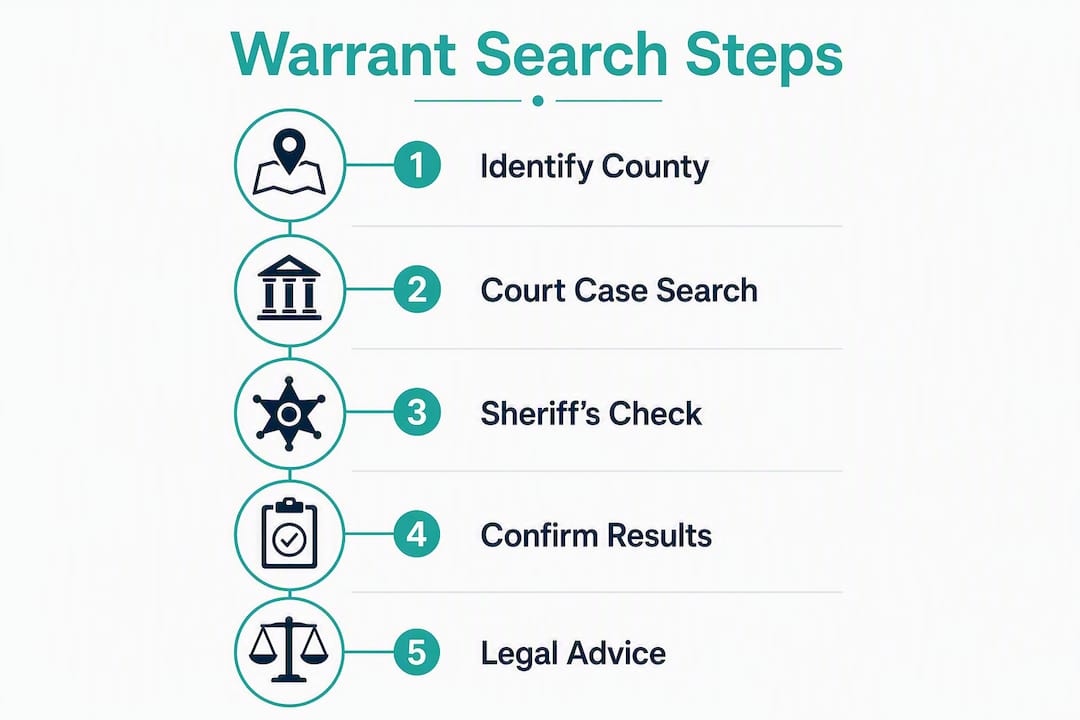
Start with the county that likely issued the warrant. Use that county’s Superior Court case search or Sheriff’s warrant tool online, or call the issuing office directly. California has no single statewide warrant database — every warrant lives in a county-level record system, which means a statewide search engine simply does not exist.
Before you do anything else, run through this short checklist:
- Collect your full legal name, any known aliases, and your date of birth.
- Identify the county where the warrant was most likely issued (where the arrest, citation, or court case occurred).
- Try that county’s online Superior Court case search or Sheriff warrant query first.
- If the online tool returns nothing or is unavailable, call the court clerk’s criminal division or the Sheriff’s warrant unit directly.
- Do NOT walk into a police station or sheriff’s office to ask in person. An attorney can often verify warrant status discreetly without putting you at risk of immediate arrest.
That last point matters more than people realize. A quick phone call to a criminal defense attorney before any in-person contact can be the difference between a controlled, negotiated surrender and an unexpected arrest at the front desk.
Table of Contents
- Why California has no single statewide warrant lookup
- How to search for warrants online, step by step
- What to do when the online search comes up empty
- How to read what the search results actually tell you
- Why third-party “warrant search” websites are unreliable
- If you find a warrant: a safety-first sequence
- What is a bail bond and how does it work?
- Other types of warrants in California you should know about
- What happens if you ignore a warrant in California
- How to search for a warrant on someone else’s behalf
- Key Takeaways
- The part most guides skip over
- Fast release after a warrant: how Armstrongbailbonds can help
- Authoritative resources for California warrant searches
Why California has no single statewide warrant lookup
California’s 58 counties each run their own Superior Court, and each Superior Court manages its own criminal case dockets, including bench warrants. The county Sheriff’s Office handles active arrest warrants for that jurisdiction. No state agency consolidates all of this into one searchable database.
The California Courts website offers a Find Your Court tool at courts.ca.gov/find-my-court, but it is a locator only. It tells you which courthouse serves a given zip code. It does not search case records or flag warrants — a distinction that trips up a lot of people who assume they’ve run a statewide check when they haven’t.
At the state level, the California Department of Justice offers a formal Record Review process for individuals who want an official criminal history summary. It requires fingerprinting and a fee, and it is not a same-day warrant search. Think of it as a backup for record-accuracy disputes, not a quick warrant check.
The two authoritative sources for most warrant searches are:
- County Superior Court: — Holds criminal case dockets and issues bench warrants (typically for failure to appear or contempt).
Start with the county where you believe the warrant originated. If you’re not sure which county, courts.ca.gov/find-my-court helps you identify the right courthouse.
How to search for warrants online, step by step
What to have ready before you search
Gather this information before opening any search tool:
- Full legal name (exactly as it appears on government ID)
- Known aliases or name variations (maiden name, nicknames used in prior records)
- Date of birth
- Case number or citation number, if you have it
- Last known county of arrest or citation
Step 1: Identify the right county court
Go to courts.ca.gov/find-my-court and enter the city or zip code where the incident occurred. The tool returns the correct Superior Court branch. Note the court’s name and address — you’ll need it if the online search fails.
Step 2: Search the county Superior Court’s case lookup
Most California Superior Courts offer a public case search by defendant name and date of birth. The Los Angeles Superior Court’s Public Access Online Services lets you search criminal case numbers by defendant name, though detailed case summaries may require paid access or a separate service request. Practices and fees vary by county, so read the court’s posted instructions before assuming a free full record is available.

Step 3: Check the county Sheriff’s warrant query
Many Sheriff’s offices publish a public warrant search tool. San Diego County Sheriff’s warrant query updates roughly hourly, though the department warns the data may lag and is informational only. Napa County’s online warrant search lets you enter a partial name and narrow results with a four-digit birth year. Search by name, include date of birth where the tool allows it, and try partial-name or wildcard entries if the full name returns nothing.
Pro Tip: Try every reasonable spelling variation of the name, including hyphenated versions and common misspellings. If you’re unsure of the county, run the search in two or three likely counties before concluding no warrant exists.
County tools vary widely: some update hourly, some daily, and some require appointments or fees for detailed records. Always check the “last updated” notice on the page and read any posted disclaimers before drawing conclusions.
What to do when the online search comes up empty
A blank result does not mean no warrant exists. The record may be sealed, the database may be behind on updates, or the warrant may be filed under a name variant you haven’t tried. Here’s how to follow up offline.
Who to contact:
- County Superior Court clerk’s office (criminal division): Call during business hours and ask for the criminal filing window or warrant unit. They can confirm whether a case exists and whether a warrant is active.
- County Sheriff’s warrant unit or Central Warrant Repository (CWR): Some counties, including Orange County, maintain a CWR where staff can run a warrant inquiry when you provide a date of birth. Orange County Sheriff’s FAQ confirms that CWR staff can check outstanding local warrants with a date of birth provided.
What to say on the call:
Identify yourself as calling to make a public records or warrant inquiry. Provide the full legal name, date of birth, any known aliases, and last known county of residence. Ask specifically:
- Is there an active warrant on file for this person?
- If yes, what are the charges and the bail amount?
- What is the case number and issuing court?
- Does appear in person to address this warrant risk immediate arrest?
Some offices require a formal records request or a small fee for written confirmation. If the clerk asks you to come in, consult an attorney first.
Pro Tip: Never call from a phone number registered to the subject of the warrant search if you are that person. Use a separate line or call through your attorney’s office to avoid any risk of location tracking or an unexpected visit.
How to read what the search results actually tell you
Online warrant and case search tools use status labels that carry real legal weight. Here’s what the common ones mean:
| Status Label | What It Means | Who Acts on It |
|---|---|---|
| Active / Outstanding Warrant | A judge has signed a warrant; law enforcement can arrest on sight | Peace officers (police, sheriff’s deputies) |
| Bench Warrant | Issued by a judge, usually for failure to appear or contempt of court | Peace officers; court clerk may schedule a recall hearing |
| Recalled / Quashed | The warrant has been withdrawn by the court; no longer enforceable | No enforcement action; confirm in writing |
| Dismissed | The underlying case was dismissed; warrant no longer active | No enforcement action |
| Sealed / Expunged | Record is not publicly visible; requires court order to access | Not available through public search tools |
A bench warrant and an arrest warrant are not the same thing. A bench warrant typically originates from a court proceeding (a missed hearing, unpaid fines) and is issued by the judge directly. An arrest warrant is issued after a showing of probable cause, usually tied to a new criminal charge. Both authorize arrest, but the path to resolving them differs.
San Diego County’s warrant tool explicitly states that its database is informational only and that only peace officers can execute an arrest on an outstanding warrant. If you find an active entry, get the case number and call the issuing court clerk to confirm the status and last-updated date before taking any action.
Why third-party “warrant search” websites are unreliable
Paid and free third-party warrant lookup sites pull from aggregated public records that are often weeks or months out of date. Legal experts caution that these services can be inaccurate and should not be relied on for legal decisions — a recalled warrant might still show as active, or an active warrant might not appear at all.
The practical risks go beyond bad data:
- Accuracy: Third-party aggregators do not have direct access to court or sheriff databases. They scrape and cache public records on their own schedule.
- Privacy: Entering your full name, date of birth, and address into an unknown commercial site creates a data trail you cannot control.
- Cost: Many charge fees for “full reports” that provide no more information than a free official portal.
Official sources to use instead:
- County Superior Court case search portals (linked directly from the court’s official website)
- County Sheriff’s warrant query pages (linked from the Sheriff’s official .gov or .ca.gov domain)
- California DOJ Record Review for formal criminal history (oag.ca.gov)
Pro Tip: Verify the URL before entering any personal information. Official California court and sheriff sites end in .ca.gov or .gov. If the domain is a .com or .net with “warrant” or “records” in the name, treat it as a commercial aggregator and use an official source instead.
If you find a warrant: a safety-first sequence
Finding an active warrant does not mean arrest is inevitable. The sequence below gives you the best chance of resolving it on your terms.
- Call a criminal defense attorney immediately. Do not contact law enforcement, appear in court, or attempt voluntary surrender before speaking with counsel. An attorney can often verify the warrant details without exposing you to arrest and may file a motion to quash or recall the warrant, which can resolve the matter without any arrest at all.
- Confirm the warrant details. Get the case number, charges, issuing court, and bail amount. Your attorney can pull this from official sources.
- Discuss voluntary surrender vs. negotiated appearance. Attorneys can often arrange a surrender at a specific time and location, with bail pre-arranged, so you are processed and released the same day.
- Arrange bail in advance. Knowing the bail amount before surrender means you can have a bail bond in place before you walk in, which dramatically shortens the time spent in custody. Learn more about how bail works in California before you commit to a plan.
- Surrender with counsel present or coordinated. Never surrender alone if you can avoid it.
Pro Tip: If the warrant was issued in a different county than where you currently live, the logistics get more complicated. A bondsman experienced with out-of-county warrants can help coordinate release across jurisdictions — see Armstrongbailbonds’s guide on out-of-county warrant bail for specifics.
Ignoring a warrant does not make it go away. Active warrants entered into the National Crime Information Center (NCIC) can result in arrest during a routine traffic stop anywhere in the country. Additional charges for failure to appear can stack on top of the original offense, and courts tend to set higher bail for defendants who were already on a warrant.
What is a bail bond and how does it work?
A bail bond is a surety contract. A licensed bondsman posts the full bail amount on your behalf in exchange for a signed agreement and a fee, typically a percentage of the total bail set by the court. In California, that fee is regulated by the Department of Insurance. Understanding what a bail bond is and how to get one is worth doing before you need one urgently.
Before signing with any bail company, ask:
- Is the company licensed by the California Department of Insurance?
- What is the fee percentage, and are payment plans available?
- What collateral, if any, is required?
- How quickly can they secure release after booking?
- Do they handle out-of-county warrants?
Typical release timelines after a bail bond is posted range from a few hours to overnight, depending on the jail’s processing speed and the time of day. The bondsman handles the paperwork with the jail; the attorney handles the court side. The two roles are separate but complementary.
Pro Tip: Even if you can pay cash bail, a bail bond often makes financial sense. Cash bail ties up the full amount until the case resolves, which can take months or years. A bond frees that capital immediately.
Other types of warrants in California you should know about
Most personal warrant searches focus on arrest warrants and bench warrants, but California courts and law enforcement issue several other types that can affect you.
Search warrants authorize law enforcement to search a specific location for evidence. They are issued by a judge based on probable cause and are not tied to an individual’s criminal record in the way an arrest warrant is. A search warrant does not show up in a public case search under your name unless it is connected to a filed criminal case.
Probation violation warrants are issued when a person on probation allegedly fails to meet the terms of their supervision — missed check-ins, failed drug tests, new arrests. These function like arrest warrants and can be executed by any peace officer. They often carry no bail or very high bail because the court views the defendant as a flight risk.
Out-of-state warrants entered into NCIC are enforceable across state lines. California law enforcement can hold someone on an out-of-state warrant pending extradition proceedings, though the issuing state must formally request extradition.
Civil bench warrants can be issued in family court or civil proceedings for failure to comply with court orders, such as child support. These are distinct from criminal warrants but can still result in detention.
For a personal warrant search, the types that matter most are arrest warrants and bench warrants — those are the ones that appear in county Sheriff and Superior Court databases. Search warrants and probation warrants tied to an active case may appear as case entries but are not always labeled separately in public search tools.
What happens if you ignore a warrant in California
An unresolved warrant does not expire. California courts do not automatically recall warrants after a set period, and the consequences of leaving one unaddressed compound over time.
The most immediate risk is arrest during a routine encounter with law enforcement — a traffic stop, a noise complaint, even a call you make to police for an unrelated reason. Officers run names through NCIC and state databases during nearly every stop. If a warrant is active, arrest follows.
Beyond the arrest itself, courts treat defendants with outstanding warrants more harshly at arraignment. Bail is often set higher, or denied entirely, because the warrant signals to the judge that the defendant did not appear when required. A failure-to-appear charge can be added on top of the original offense, which means more counts, more potential penalties, and a longer case.
If the warrant is entered into NCIC, it is visible to law enforcement nationwide. Traveling, crossing a border checkpoint, or even applying for certain jobs or licenses can surface it. Some employers and licensing boards run background checks that flag active warrants, which can affect employment and professional licenses before any conviction occurs.
How to search for a warrant on someone else’s behalf
Searching for a warrant on behalf of another person is legal using public records tools, but it comes with practical and ethical considerations worth thinking through carefully.
Step 1: Use only official public records tools. County Superior Court case searches and Sheriff warrant query pages are public records. You do not need the subject’s permission to search them, and no login or special authorization is required.
Step 2: Collect accurate identifying information. You need the person’s full legal name, date of birth, and the most likely county. Searching with incorrect information wastes time and can produce false results. If the person is a family member or close contact, confirm the spelling of their legal name against a government ID if possible.
Step 3: Do not share results carelessly. If you find an active warrant, the information is sensitive. Sharing it with the wrong person — or posting it publicly — can create safety risks for the subject and legal exposure for you if the disclosure lead to harm.
Step 4: Encourage the subject to contact an attorney. If you find a warrant for someone else, the most useful thing you can do is connect them with a criminal defense attorney rather than advising them on what to do directly. You are not their legal counsel, and well-meaning advice can lead to bad decisions.
Privacy note: Third-party warrant search sites that require you to enter someone else’s personal information are a privacy risk for both of you. Stick to official government portals.
Key Takeaways
California warrant searches must start at the county level — there is no statewide database, and every official record lives with the county Superior Court or Sheriff’s Office that issued it.
| Point | Details |
|---|---|
| County-first approach | Search the county Superior Court and Sheriff where the warrant was likely issued — no statewide tool exists. |
| Verify ambiguous results | Call the issuing court clerk with the case number to confirm status and last-updated date before acting. |
| Attorney before surrender | Contact a criminal defense attorney before any in-person contact; counsel can verify status and may file a motion to quash. |
| Avoid third-party sites | Official .ca.gov and .gov portals are more accurate and safer than commercial aggregator sites. |
| Armstrongbailbonds | If a warrant leads to arrest, Armstrongbailbonds offers 24/7 bail bond services across Southern California with fast release and flexible payment options. |
The part most guides skip over
Most warrant-search articles stop at “use the official county tool.” That is correct advice, but it misses the harder truth: finding a warrant is the easy part. What you do in the next 24 hours determines whether the situation resolves quietly or escalates into a public arrest.
The conventional wisdom says “turn yourself in.” That framing is incomplete. Voluntary surrender is often the right move, but only after an attorney has confirmed the warrant details, assessed the charges, and arranged bail in advance. Walking in without that preparation means you are entirely at the mercy of the jail’s processing timeline and the court’s next available arraignment date.
There is also a widespread assumption that bench warrants are less serious than arrest warrants. They are not. A bench warrant for failure to appear can carry the same arrest authority as a warrant issued after a criminal investigation. Courts treat them as a signal that the defendant cannot be trusted to appear voluntarily, which affects bail decisions and judicial temperament throughout the case.
The readers who handle this best are the ones who treat the warrant search as the beginning of a legal process, not the end of one. Find the warrant, confirm it, call an attorney, and then move. That sequence, done in order, gives you options. Skipping steps removes them.
Fast release after a warrant: how Armstrongbailbonds can help
Once a warrant leads to booking, the clock starts. Armstrongbailbonds has been posting bail across Southern California since 1926, and the practical advantage is speed: bail processing that often results in release within 30 minutes of the bond being approved.

For readers who just confirmed an active warrant, here is what Armstrongbailbonds offers that matters most right now: 24/7 availability, an online application so the process can start before booking is even complete, flexible payment plans including 2% bail bond options, and bilingual English/Spanish staff. They handle misdemeanor, felony, and property crime charges across Los Angeles, San Diego, and surrounding Southern California counties.
To get started, have the following ready: the subject’s full legal name, date of birth, booking number, and the county jail where they are or will be held. Then call or apply online. For a clear breakdown of what a bail bond actually costs and why it often beats paying cash, read about bail bond benefits before you decide.
Authoritative resources for California warrant searches
| Resource | What It Provides |
|---|---|
| courts.ca.gov/find-my-court | Locates the correct county Superior Court by city or zip code; does not return warrant status |
| LA Superior Court Public Access | Criminal case number search by defendant name; detailed summaries may require paid access |
| San Diego County Sheriff Warrant Query | Public warrant search by name; updates roughly hourly; informational only |
| Napa County Online Warrant Search | Name-based search with optional birth year filter; partial-name entries accepted |
| Orange County Sheriff FAQs / CWR | Central Warrant Repository staff can check outstanding local warrants with a date of birth |
| California DOJ Record Review (oag.ca.gov) | Formal criminal history summary via fingerprinting and fee; not a real-time warrant search |
This article is general information, not legal advice. Warrant status, bail amounts, and court procedures change frequently. Confirm current details with the issuing court, a licensed California attorney, or a qualified bail professional before taking any action.