
Paperwork to Secure Same Day Release for Assault Bail in California

Most people arrested for assault in California can post bail and go home the same day. Only the most serious violent charges, like assault causing great bodily injury to a public official or aggravated cases tied to a criminal street gang, can lead to a judge denying bail outright. Your fastest paths out are release on your own recognizance, cash bail, a bail bond through a licensed agent, or, rarely, a property bond. If the number posted is too high, a lawyer can request a bail-reduction or Humphrey hearing.
TL;DR:
- Most assault defendants in California can be released on their own recognizance or with a bail bond, with only the most serious cases being denied bail outright.
- Bail amounts vary by county, but simple misdemeanor assault usually involves lower five-figure sums, while felony assault with injuries or weapons can require bail from high five figures to six figures.
- Judges consider flight risk, danger to the victim or public, criminal history, and case severity when setting or modifying bail, with serious violent felonies often resulting in no bail.
- Post-bail, options include cash payment, bond through a licensed agent, or property bond, with bonds often requiring a non-refundable premium and collateral.
- Defense attorneys can challenge high bail amounts through hearings based on inability to pay, especially if the defendant has strong ties to the community and no recent criminal record.
Table of Contents
- What Determines Assault Bail in California
- How Much Is Assault Bail in California?
- How Judges Set or Change Bail in Assault Cases
- Posting Bail: Cash, Bond, or Property, Step by Step
- Asking for a Bail Reduction When You Can’t Afford It
- Bail Conditions and What Happens If You Break Them
- How Armstrong Bail Bonds Handles Assault Cases
- What To Do Right Now if Someone You Know Was Just Arrested
- Get Assault Bail Posted Fast With Armstrong Bail Bonds
- Where This Article’s Numbers Come From
- Sources
- FAQ
What Determines Assault Bail in California
When someone gets booked on an assault charge, the county’s bail schedule sets the starting number, not a judge. Every California county publishes its own schedule, which deputies and jail staff use to calculate a presumptive amount before anyone sees a courtroom. A judge can later raise or lower that figure based on the case, but the schedule is the default at intake.
California law does not allow a court to keep someone locked up purely because they cannot afford the number on the schedule. Judges are required to consider releasing defendants on their own recognizance or under nonfinancial conditions when the circumstances allow it, particularly for lower-level offenses and first-time defendants.
Three outcomes are possible after an assault arrest:
- Release on your own recognizance (OR): no money changes hands; the defendant signs a promise to appear.
- Held on bail: a dollar amount is set, and release happens once that amount, or the required bond premium, is posted.
- Held without bail: reserved for the most serious violent felony charges, gang enhancements, or cases with a documented flight or safety risk.
Practitioners who handle these cases regularly note that many defendants facing lower-level assault charges, especially those without prior records, get released OR rather than having to post anything at all. That is worth remembering before you assume you need cash on hand.
How Much Is Assault Bail in California?
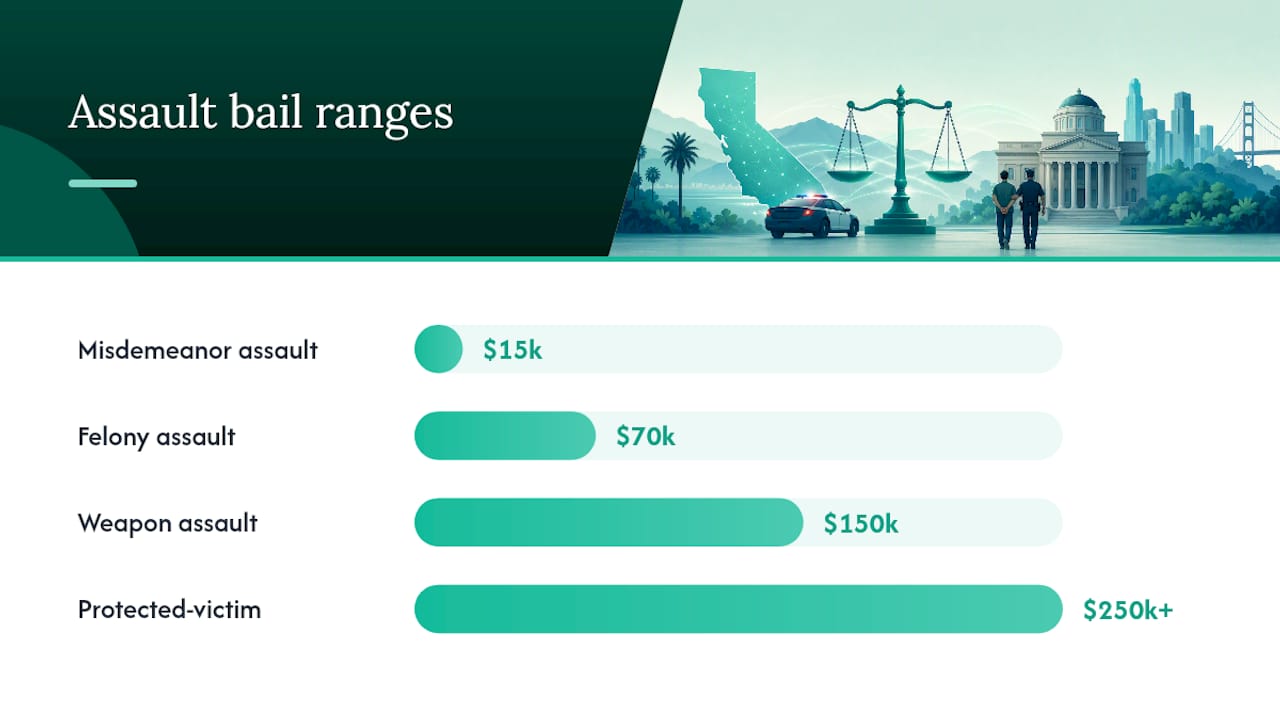
Numbers vary by county, but the pattern is consistent: the more severe the charge, the steeper the schedule jumps. Simple misdemeanor assault, the kind that doesn’t involve a weapon or serious injury, tends to have lower bail amounts on most county schedules. Felony assault, including assault likely to cause great bodily injury, generally requires a higher bail amount. Use of a firearm or deadly weapon typically results in a significantly increased bail, potentially reaching very high levels depending on the county.
Sample presumptive ranges by charge type:
- Misdemeanor simple assault: generally lower five figures
- Felony assault (aggravated or with injury): mid to high five figures
- Assault with a firearm or deadly weapon: high five figures to six figures
- Assault on a protected victim (peace officer, child, elder): schedule amounts increase further
Pro Tip: County schedules for wobbler charges, offenses that can be filed as either a misdemeanor or a felony, are usually applied at the felony level at booking. If your loved one was arrested on a wobbler, expect the higher number until a prosecutor formally files the case, and don’t be shocked if bail drops once charges are actually filed.
The Yuba County felony bail schedule is a useful real-world example. It lists specific presumptive amounts tied to individual Penal Code sections and shows how the number climbs when a weapon is involved or the victim falls into a protected category, such as a peace officer or public servant. Multiple alleged victims in one incident can also push the total higher, since some schedules calculate bail per count.
How Judges Set or Change Bail in Assault Cases
A judge reviewing bail on an assault case is weighing a short list of factors, and they carry different weight depending on the facts.
- Flight risk: ties to the community, employment, and past court appearance history.
- Danger to the alleged victim or the public: the nature of the assault, any weapon involved, and whether there’s a restraining order in play.
- Criminal history: prior convictions, especially prior violent offenses, tend to push bail up.
- Severity of the alleged conduct: whether the assault caused injury, involved a weapon, or targeted a protected victim.
Beyond the county schedule itself, several statutory and procedural pieces matter here. Marcy’s Law, codified in Penal Code section 1270.1, requires notice to the alleged victim and a hearing before certain violent felony defendants can be released on OR or reduced bail. That single procedural requirement explains why some assault cases move slower through the release process than others, even when the underlying facts look similar.
Bail can be denied entirely, or set extremely high, in cases involving serious violent felonies where the court finds clear and convincing evidence that no condition of release can protect public safety. That is the exception rather than the rule for most assault arrests, but it does happen with aggravated cases or defendants who have a documented history of violence. For a deeper look at how these calculations play out, see how bail is calculated across different charge categories.
Posting Bail: Cash, Bond, or Property, Step by Step
Once bail is set, three legal posting methods exist in California, and the right one depends on how fast you need release and how much cash you have on hand.
- Confirm the details first. Call the jail or use its online inmate locator to confirm the booking number, exact charge, and bail amount before you do anything else.
- Decide how you’re posting. You can pay the full cash bail amount directly to the jail or court, or contact a licensed bail agent to post a bond instead.
- If posting a bond, expect to pay a premium. California caps the bail bond premium; agents typically charge a set percentage of the total bail, which is non-refundable once the bond is written.
- Provide a cosigner and, if required, collateral. Bail agents often require someone with steady income or assets to cosign, and larger bonds may require collateral like a vehicle title or home equity.
- Wait for processing. Once paperwork clears, release from most county jails happens within a few hours; a licensed agent generally moves faster than the jail’s own cash-processing line.
A property bond is the third legal option, but it’s rarely used in practice. It requires real property with equity worth roughly twice the bail amount, plus a formal appraisal and lien filing, a process that can take days rather than hours. Property bonds remain uncommon precisely because appraisal and lien requirements slow everything down when speed is usually the point.
Pro Tip: If you’re choosing between cash and a bond, run the math on tying up the full bail amount for months versus paying a smaller, non-refundable premium now. For a lot of families, freeing up that cash for a lawyer’s retainer matters more than avoiding the bond fee.
Asking for a Bail Reduction When You Can’t Afford It
If the number on the schedule is out of reach, the fix isn’t to skip bail entirely, it’s to challenge it. A defense attorney can file a motion for a bail-reduction hearing, sometimes called a Humphrey hearing when the argument centers on inability to pay, and courts often schedule these within days of arraignment.
Evidence that tends to move the needle:
- Proof of steady employment or a job offer waiting
- A stable address and family ties in the county
- Enrollment in counseling or treatment programs, if relevant
- No prior criminal record, or a clean record for several years
- Letters or statements from community members vouching for the defendant
If a judge denies the reduction, the defense isn’t out of options. Bail can be re-argued at a later hearing as new evidence surfaces, and in some cases, appellate review is available. Anyone stuck at this stage should look into what happens when you can’t afford bail in California before assuming there’s nothing left to try.
Bail Conditions and What Happens If You Break Them
Getting released is not the end of the court’s involvement. Almost every assault case comes with conditions attached to bail, and violating them carries real consequences.
- No-contact orders with the alleged victim
- Weapons restrictions, often a full ban on possession
- Travel limits, sometimes confined to the county or state
- Curfews or electronic monitoring in higher-risk cases
- Regular check-ins with a supervising officer or the court
Break a condition, and the consequences move fast: re-arrest, forfeiture of the bail amount, seizure of any collateral tied to a bond, and revocation of the bond itself. Bail bond companies actively monitor compliance because their own money is on the line, and they will notify the court, and often the cosigner, the moment a violation surfaces. If a condition changes or gets confusing, call your attorney before you call anyone else.
How Armstrong Bail Bonds Handles Assault Cases
An established bail bonds company in Southern California has handled assault cases through many years of changes to state bail law. That experience shows up in a few practical ways for someone trying to get a family member out fast.
- Licensed agents are often available around the clock, and applications can sometimes start online before you leave for the jail.
- Flexible payment plans and relationships with local jail staff can often lead to release within about 30 minutes of paperwork clearing.
- Bilingual staff and an inmate search tool can help reduce the time spent on follow-up after an arrest.
These are the specific mechanics of what happens after your loved one is booked. What matters more, though, is what you do in the first hour, and that’s worth walking through on its own.
What To Do Right Now if Someone You Know Was Just Arrested
Confirm the person is safe. If anyone was injured, get medical care handled first, then contact both a criminal defense attorney and a licensed bail agent at the same time, not one after the other. Have the booking number, jail location, exact charge, a valid ID, and proof of local ties ready. That’s what actually speeds up release.
— Jake
Get Assault Bail Posted Fast With Armstrong Bail Bonds
Armstrongbailbonds is the practical alternative to waiting on a cash line at the jail counter: licensed agents answer calls around the clock, and the online application lets you start the paperwork before you’ve even left home. That speed matters most in assault cases, where county schedules can push bail into the mid five figures or higher, and every hour someone sits in county jail is an hour too many for most families.
Before you call, have the full name of the person in custody, their booking number, the jail location, and the exact charge on hand. Armstrongbailbonds staff will walk you through payment options on the spot, including 2% bail bonds and no collateral bail bonds for those who qualify, and explain exactly what a cosigner needs to bring. Coverage runs across Los Angeles, San Diego, and the rest of Southern California, with the same 24/7 licensed-agent access no matter which county the arrest happened in. Start the online bail bond application now, or call the number listed on the site to get a specific bond quote for the charge you’re dealing with.
Where This Article’s Numbers Come From
Bail ranges and posting rules here draw from the Yuba County felony bail schedule and California Courts’ statewide bail guidance. Schedules vary by county, so always check your local superior court’s current schedule before assuming a number applies to your case.
This article is general information, not a substitute for advice from a qualified lawyer. Consult a qualified legal professional about your own circumstances before acting on anything here.
Sources
- How the Bail System Works in California
- How Does Bail Work - Posting Bail in California - PC 1276, 1276.5
- Yuba County 2026 felony bail schedule (signed order)
- California Courts guidance on bail
FAQ
How Much Jail Time Is There for Assault in California?
Jail time depends heavily on whether the charge is filed as a misdemeanor or felony; misdemeanor simple assault typically carries up to a year in county jail, while felony assault with aggravating factors can carry several years in state prison. Bail amounts on the county schedule generally track this same severity scale.
Can You Beat an Assault Charge in California?
Yes, defenses like self-defense, defense of another person, lack of intent, or mistaken identity are all commonly raised, and outcomes depend heavily on the specific evidence in the case. A criminal defense attorney can evaluate which defense fits the facts and how that might affect both the charge and the bail argument.
Can You Pay Bail for Someone Else’s Assault Charge?
Yes, anyone with the funds or willingness to cosign can post bail or a bail bond on behalf of a defendant, whether that’s cash paid directly or a premium paid to a licensed agent like Armstrongbailbonds. The person posting bail becomes financially responsible if conditions are violated or the defendant fails to appear.
What Is the Lowest Level of Assault Charge in California?
Simple assault is the lowest tier, typically charged as a misdemeanor when no weapon or serious injury is involved. It carries the lowest presumptive bail amounts on most county schedules compared to felony assault variants.
How Does the Assault Bail Process Actually Work After Arrest?
After booking, jail staff apply the county’s bail schedule to set a presumptive amount, and the defendant can post that amount through cash, a bail bond, or, rarely, a property bond. If the amount is unaffordable, a defense attorney can request a bail-reduction or Humphrey hearing to argue for a lower number or OR release.