
Arrested While on Bail: What Happens Next

Getting arrested while on bail puts your current release at immediate risk. The court can revoke your existing bond, set a separate bail amount for the new charge, and in some cases hold you without bail entirely. Two things matter most right now: call your attorney and call your bondsman, in that order.
What to expect immediately:
- Your existing bond may be revoked or forfeited, even before any new conviction
- A new, separate bail amount will likely be required for the new charge
- You could be held in custody pending a revocation hearing on the original case
- Bail conditions on the original case may be tightened (GPS monitoring, drug testing, no-contact orders)
- Prosecutors may withdraw existing plea offers on the original charge
Know what you should and shouldn’t do while out on bail before any of this becomes relevant. If it already has, keep reading.
Table of Contents
- What does “arrested while on bail” actually mean?
- Immediate legal consequences you should expect after a re-arrest
- How courts treat a new arrest when you’re already out on bail
- What a bond revocation hearing looks like
- How a re-arrest affects your bail bond, cosigner, and the bondsman
- Extra penalties you may face for a new crime committed while on bail
- Immediate steps to take after someone on bail is arrested again
- What to ask your attorney and bondsman after a re-arrest
- How state and county rules change what happens next
- How bail bond companies typically respond when a client is re-arrested
- Key Takeaways
- Why early coordination matters more than most people realize
- Facing a re-arrest in Southern California? Armstrongbailbonds can help now
- Authoritative sources and statutes to check
What does “arrested while on bail” actually mean?
The phrase covers several distinct legal situations, and which one applies to you changes what happens next.

| Type of Re-Arrest | What Triggered It | Effect on Original Case |
|---|---|---|
| New criminal charge, same jurisdiction | Alleged new offense in the same county | Judge in original case can revoke bond independently |
| New criminal charge, different jurisdiction | Alleged offense in another county or state | Hold orders and custody transfers complicate both cases |
| Bail condition violation | Missed check-in, failed drug test, prohibited contact | Can trigger revocation hearing without any new crime |
| Bench warrant / failure to appear | Missed a scheduled court date | Automatic bond forfeiture risk; immediate custody likely |
A condition violation is the one people underestimate. Pretrial services reports, missed check-ins, and administrative violations can trigger the same judicial response as a new arrest. You do not need a new conviction for a judge to send you back to jail.
Immediate legal consequences you should expect after a re-arrest
The first 24 hours after a re-arrest tend to set the trajectory for everything that follows. Here is what typically happens.
- Immediate custody: You will likely be booked and held, at minimum until a hearing can be scheduled on both the new charge and the original bond.
- Separate bail on the new charge: Courts treat the new arrest as a distinct case. You will need a separate bond, and that amount is set independently of whatever you already posted.
- Bond revocation risk on the original case: A new arrest can lead to revocation of the existing bond, an increase in bail amounts, or additional conditions such as GPS monitoring. Judges often treat a re-arrest as a breach of trust.
- Forfeiture of the original bond: If the court revokes the bond before your bondsman can respond, the full bail amount may be forfeited.
- Elevated conditions or no-bail hold: Depending on the severity of the new charge, a judge may impose stricter conditions or deny bail entirely on the original case.
Pro Tip: Act within hours, not days. Automatic forfeiture timelines vary by county, but waiting even 48 hours can eliminate options your attorney might otherwise have used to preserve your release.
How courts treat a new arrest when you’re already out on bail
Courts typically treat a new arrest as a separate case that requires a distinct bond. The original case and the new case run on parallel tracks, each with its own bail, its own hearings, and its own judge. That parallel structure is where things get complicated.
Bail stacking across multiple charges
When you face charges in the same county, most California jurisdictions require bail to be “stacked.” The San Diego Superior Court’s bail schedule explains this directly: bail is computed for each charge and then added together, including applicable enhancements and prior convictions. The exception is when offenses arise from a single, indivisible course of conduct. Knowing whether your charges qualify for that exception can meaningfully reduce your total bail exposure.
Judge’s discretion and what “no new conviction required” means
Bond revocation requires only the judge’s determination of risk or breach, not a guilty verdict on the new charge. A judge in the original case can independently decide to revoke your bond the moment they learn of the re-arrest. That decision is based on community safety, flight risk, and your compliance history up to that point. Early legal advocacy is the most effective tool to prevent extended detention, because the window to argue against revocation is narrow.
Jurisdictional complications
If the new arrest happened in a different county or state, you may face a hold order that prevents release even if you post bail on the new charge. Custody transfers between jurisdictions take time, and during that transfer period you remain in custody. Your attorney in the original jurisdiction needs to know about the new arrest immediately so they can request a bond status hearing before the hold order locks things in.
What a bond revocation hearing looks like
A revocation hearing is not a trial. Nobody is deciding guilt or innocence on the new charge. The only question before the judge is whether you should remain free while the original case continues.
- Who presents evidence: The prosecutor argues for revocation, often citing the new arrest, any pretrial services reports, and your compliance history. Your attorney argues for continued release or modified conditions.
- What judges weigh: Community safety, flight risk, the severity of the new charge, and how well you followed the original conditions up to this point.
- Possible outcomes: Continued release on the same terms; modified conditions (added GPS monitoring, higher check-in frequency, drug testing); increased bail; or immediate remand to custody.
- Timing: Request the hearing as quickly as possible. The longer you sit in custody without a hearing, the harder it becomes to argue that release is appropriate.
Bond revocation hearings are not trials on new charges; judges consider pretrial reports, prosecutor arguments, and public-safety risk when deciding whether to revoke or modify release. Your attorney’s job at this hearing is to reframe the re-arrest as a manageable risk, not a reason to hold you indefinitely.
How a re-arrest affects your bail bond, cosigner, and the bondsman
The financial and contractual fallout from a re-arrest extends beyond the defendant. Anyone who signed for the original bond is now exposed.
When a defendant is re-arrested, the surety company that backed the original bond faces potential forfeiture liability. The bondsman may respond in one of three ways: attempt to modify the bond arrangement, surrender the defendant to the court to limit financial exposure, or pursue the defendant’s location if they have absconded. Understanding whether a bondsman can pull someone’s bond matters here, because that option is real and it can happen quickly.
Cosigners carry direct financial exposure. If the bond is forfeited, the cosigner is responsible for the full bail amount, and any collateral pledged (property, vehicles, savings) is at risk. The obligations you took on when signing a bail bond contract do not pause because a new arrest occurred.
One critical misconception: posting bail for the new charge does not automatically resolve the risk that the original bond may be revoked. Judges in the original case act independently. You can be free on the new charge and simultaneously remanded on the original.
Pro Tip: If you are a cosigner, call the bondsman before the court does. Ask specifically what triggers immediate collateral collection or bond recall under your agreement. That conversation is far easier before a revocation hearing than after.
Extra penalties you may face for a new crime committed while on bail
A re-arrest does not just create a second case. In many states, it creates additional sentencing exposure on top of whatever the new charge carries.
California Penal Code Section 12022.1 is the clearest example. Under that statute, committing a felony while on bail or own recognizance (O.R.) release for a prior felony carries an enhancement, and the San Francisco Superior Court’s bail schedule lists a specific bail amount for this enhancement. That figure is separate from the bail on the underlying new charge.
Beyond enhancements, the collateral damage to the original case is significant. A second arrest can affect plea negotiations and sentencing leverage. Prosecutors may withdraw or reset plea deals entirely. A deal that was close to finalized can disappear the day after a re-arrest. The more serious the new charge, the more likely the prosecutor treats the original case as a fresh negotiation from a position of strength.
Misdemeanor re-arrests carry less enhancement risk than felonies, but they still signal to the court that you are a compliance risk. Even a minor new charge can shift a judge’s view of your original case at sentencing.
Immediate steps to take after someone on bail is arrested again
The first 72 hours determine whether this situation stays manageable or spirals. Here is the order of operations.
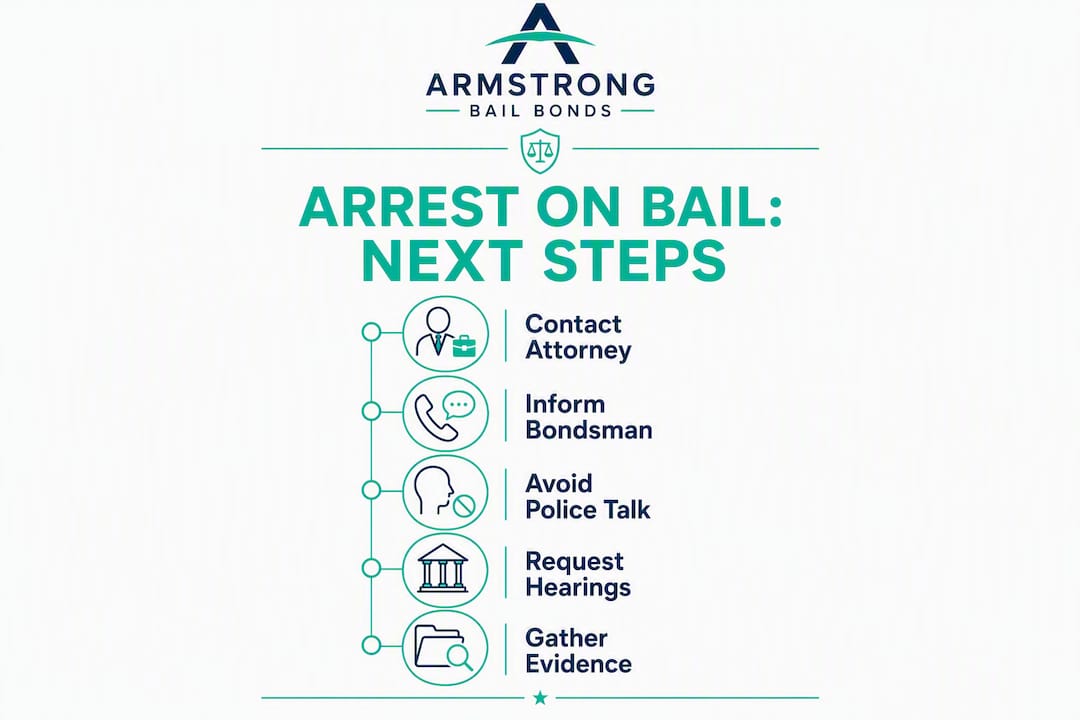
1. Contact the defendant’s attorney immediately. Not tomorrow. Not after you figure out what happened. The attorney needs to know about the re-arrest before the court does, if possible, so they can request a bond status hearing in the original case. Early legal representation is the single most effective tool for preventing extended detention.
2. Call the bondsman with full arrest details. Give them the arresting agency, the charge, the booking number, and the jail location. Bondsmen who know about a re-arrest early have more options than those who find out from a court notice.
3. Do not speak to police without counsel. This applies to the new charge and to any questions about the original case. Anything said voluntarily can be used in both proceedings.
4. Request prompt hearings on both cases. Your attorney should file for a bond hearing in the original case and arrange representation for the new charge simultaneously. Treating these as sequential rather than parallel is a common mistake that costs time in custody.
Pro Tip: Gather mitigating evidence now: proof of compliance with original bond conditions (check-in records, drug test results, employment records, medical documentation). This material is most persuasive at a revocation hearing, and it becomes harder to collect once you are in custody.
What to ask your attorney and bondsman after a re-arrest
The right questions get you the right information fast. Here is a working checklist.
Ask your attorney:
- Is the judge in the original case likely to revoke bond based on this arrest?
- Can we request an emergency bond hearing before the court acts on its own?
- Do we need to post a separate bond for the new charge, and what amount are we looking at?
- Does the new charge trigger any sentencing enhancements on the original case?
- How does the new arrest affect any existing plea offer?
Ask your bondsman:
- What are my financial obligations now that a re-arrest has occurred?
- Will you recall or surrender the bond, and under what conditions?
- What happens to any collateral if the original bond is forfeited?
- Can you post a new bond for the new charge, and what are the terms?
- What information do you need from me right now?
Document every conversation with a date and time. Request written confirmation of any decisions the bondsman makes about the bond status. If a hearing date is set, confirm it in writing with both your attorney and the court clerk. Local courthouse procedures vary, and a missed hearing date on top of a re-arrest is a combination that almost always results in immediate custody.
How state and county rules change what happens next
Bail procedures are not uniform across California, let alone across the country. County bail schedules set the presumptive amounts, and those schedules contain specific rules for defendants who are already out on bail when a new arrest occurs.
| County | Rule for Defendants Already Out on Bail | Example Figure |
|---|---|---|
| San Diego County | Bail stacking required for multiple charges; exception for single indivisible course of conduct | Stacking rules detailed in 2026 bail schedule |
| San Luis Obispo County | Presumptive higher bail for some misdemeanor exceptions when already out on bail | Presumptive higher bail amounts apply for certain misdemeanor exceptions and DUI conditions according to the county bail schedule |
| San Francisco County | PC 12022.1 enhancement listed separately in bail schedule | The schedule lists a separate bail amount for offenses committed while on bail or O.R. |
If the new arrest happened in a different county than the original case, you may face a hold order from the original county. That hold prevents release even after posting bail on the new charge. Extradition between California counties is typically handled through a court order rather than a formal extradition proceeding, but it still takes time and requires coordination between two sets of attorneys.
When the new arrest crosses state lines, the process is slower and more expensive. Interstate detainers and extradition hearings can keep a defendant in custody for weeks. Local counsel in both jurisdictions is not optional in that scenario.
How bail bond companies typically respond when a client is re-arrested
A bondsman’s response to a re-arrest depends on how much risk the situation creates for the surety. The options are not limited to “post a new bond” or “walk away.”
Most bondsmen will first try to assess whether the defendant is likely to appear for future hearings. If the re-arrest was for a minor charge and the defendant has a strong compliance history, many bondsmen will work with the family to arrange a new bond on the new charge while monitoring the status of the original bond. Communication between the bondsman and the defense attorney at this stage often determines how quickly the defendant gets out.
When the risk is higher, a bondsman may choose to surrender the defendant to the court. This limits the surety’s financial exposure by ending the bond obligation before forfeiture occurs. Families sometimes view this as a betrayal, but from the bondsman’s perspective it is a contractual right and a financial necessity.
What families should have ready when they call: the defendant’s full legal name, booking number, arresting agency, the new charge, and the jail location. The faster a bondsman can verify the situation, the faster they can act. Armstrongbailbonds operates 24/7 and has direct relationships with local jails and courthouses across Southern California, which shortens the time between a call and a concrete plan.
Pro Tip: Ask your bondsman whether they can coordinate directly with the defense attorney. When the bondsman and attorney are aligned on strategy, the defendant’s release timeline shortens considerably. Bondsmen who have existing relationships with local court staff can often get accurate hearing times faster than families calling the courthouse directly.
Key Takeaways
Getting arrested while on bail creates two simultaneous legal problems: the original bond is at immediate risk of revocation, and the new charge requires its own separate bail.
| Point | Details |
|---|---|
| Bond revocation is immediate risk | A judge can revoke your existing bond based on a re-arrest alone, no new conviction required. |
| New charge means a new, separate bond | Courts treat each arrest as a distinct case; posting bail on the new charge does not protect the original bond. |
| Act within 72 hours | Contact your attorney and bondsman immediately; delays narrow your options and increase custody time. |
| County bail schedules set the numbers | California counties like San Diego and San Luis Obispo have specific stacking rules and presumptive amounts for defendants already out on bail. |
| Armstrongbailbonds can respond immediately | With 24/7 availability and local courthouse experience across Southern California, Armstrongbailbonds can coordinate rapid release on both the original and new charges. |
Why early coordination matters more than most people realize
The conventional wisdom after a re-arrest is “get a lawyer.” That is correct, but incomplete. The part that gets skipped is the coordination between the attorney and the bondsman, and that gap is where defendants spend the most unnecessary time in custody.
A revocation hearing on the original bond can happen within days of a re-arrest. If the bondsman and attorney are not communicating, the attorney may argue for continued release while the bondsman is simultaneously moving to surrender the bond. Those two actions cancel each other out, and the defendant stays locked up while the paperwork sorts itself out.
The other thing people underestimate is how much a defendant’s compliance history matters at a revocation hearing. Judges are not just looking at the new arrest in isolation. They are looking at the entire pretrial record: every check-in, every drug test, every court appearance. A defendant who has been scrupulously compliant for months has a genuinely different argument than one who has missed check-ins. That history needs to be documented and presented, and it needs to happen fast.
The practical implication is simple: treat the first phone call after a re-arrest as a three-way conversation, not two separate ones. Attorney, bondsman, and family on the same page from hour one.
Facing a re-arrest in Southern California? Armstrongbailbonds can help now
A re-arrest creates two bail problems at once, and the clock starts immediately. Armstrongbailbonds has been handling exactly these situations across Southern California since 1926, with direct courthouse relationships in Los Angeles, San Diego, and surrounding counties that translate into faster answers and faster releases.

When a client is re-arrested, Armstrongbailbonds can assess the new charge, coordinate with the defense attorney, and move on posting a new bond while monitoring the status of the original. Flexible payment options, including 2% bail bonds for qualifying clients, mean financial strain does not have to extend custody time. Bilingual staff are available around the clock. Learn more about bail bond benefits you may not know about, or if you need to understand how bail works in California before making a decision, that resource is there too.
Call Armstrongbailbonds now or start an online application. Have the defendant’s booking number, arresting agency, and charge ready. The sooner you call, the more options are still on the table.
This article provides general legal information about bail procedures in the United States. It is not legal advice. Bail rules vary by state and county. Consult a licensed attorney and verify current rules with the relevant court for your specific situation.
Authoritative sources and statutes to check
- Superior Court of California, San Francisco County: 2025–2026 Bail Schedule — Lists the PC 12022.1 enhancement bail amount ($50,000) for offenses committed while on bail or O.R.
- Superior Court of California, County of San Diego: 2026 Bail Schedule — Explains bail stacking rules and the exceptions for indivisible conduct; essential for anyone arrested on multiple charges in San Diego County.
- Superior Court of California, County of San Luis Obispo: 2025 Bail Schedule — Contains specific presumptive bail amounts for defendants already out on bail, including misdemeanor exceptions and DUI conditions.
- Schwartz & Cohen: What Happens If Indicted While Out on Bond — Explains the separate-case treatment of new arrests and why posting a new bond does not protect the original.
- Fort Worth Defense: Can You Be Arrested Again After Posting Bail in Texas? — Covers bond revocation triggers, plea negotiation impact, and non-criminal violation triggers; applicable as a general framework even outside Texas.
- Connecticut Judicial Branch: Bail FAQs — Clear explanation of how bail amounts are set and the role of pretrial services.
For precise application to your county, consult the relevant county bail schedule directly or speak with a licensed attorney in that jurisdiction.
Recommended
- Armstrong Bail Bonds | What Happens If The Defendant Doesn’t Appear For Their Court Date After They Were Bailed Out?
- Armstrong Bail Bonds | What Happens To The Money After You Post Bail?
- Armstrong Bail Bonds | What You Should And Shouldn’t Do While Out On Bail
- Armstrong Bail Bonds | How To Get Someone Out of Jail with No Money