
After an Arrest in California: Steps for You and Your Family

After an arrest in California, the person is booked into jail, may be released with a court date or on bail, and otherwise must see a judge within about 48 hours, not counting Sundays and court holidays. The fastest way for a family to help is to find out where the person is held, learn the bail amount, and arrange release while the person says nothing about the case. We are Armstrong Bail Bonds, a family-owned Southern California bail agency since 1926, and this is the order we would walk a relative through.
TL;DR
- The person arrested should stay calm, say they want to remain silent and want an attorney, and not discuss the case, including on jail phone calls.
- A person held in custody must generally be arraigned (see a judge for the first time) within 48 hours, excluding Sundays and court holidays.
- Release can happen before court through bail, or at court through release on recognizance, supervision or bail. Some people are held without bail.
- Families can start by locating the person and confirming the bail amount. Our agents answer 24/7 and the application can begin online.
- After release, the job is simple: appear at every court date and tell the lawyer about any new citation or arrest.
Table of Contents
- The first hours: what the arrested person should do
- What happens at the jail: booking and the three paths
- Step 1 for the family: find out where they are
- Step 2: understand the 48-hour clock
- Step 3: choose how to seek release
- Step 4: sign the bond and what you are agreeing to
- Step 5: how fast is release
- Step 6: the first court date
- After release: how to keep the bond and the case on track
- Fast reference: first 72 hours
- Getting your person home with Armstrong Bail Bonds
- Our perspective
- FAQ
- Sources
The first hours: what the arrested person should do
The person’s first job is to protect the case. San Francisco’s official rights guide says to stay calm, follow officers’ directions, say you want to remain silent and want an attorney, avoid discussing the case or immigration status with anyone except counsel, and not sign anything without an attorney.
That applies to relatives too. Solano County’s Public Defender warns that jail calls, social visits, video chats and letters may be recorded or read and used in court. When you speak with your loved one, talk about logistics: who is coming, what they need, how the family is. Leave out what happened.
An arrest is not a conviction, and it must rest on probable cause, meaning facts that would lead a reasonable officer to believe a crime occurred. California’s peace officer training body explains that an arrest is taking a person into custody in a manner authorized by law, with or without a warrant depending on the circumstances. Whether it was lawful is a question for a defense attorney, not something to argue at the scene.
What happens at the jail: booking and the three paths
After arrest, the person is taken to a jail and booked: identity, charges, fingerprints, belongings. The Los Angeles Superior Court describes three outcomes: the person may be released without charges, post bail or be released on their own with a court date, or stay in custody and be taken to court to see a judge.
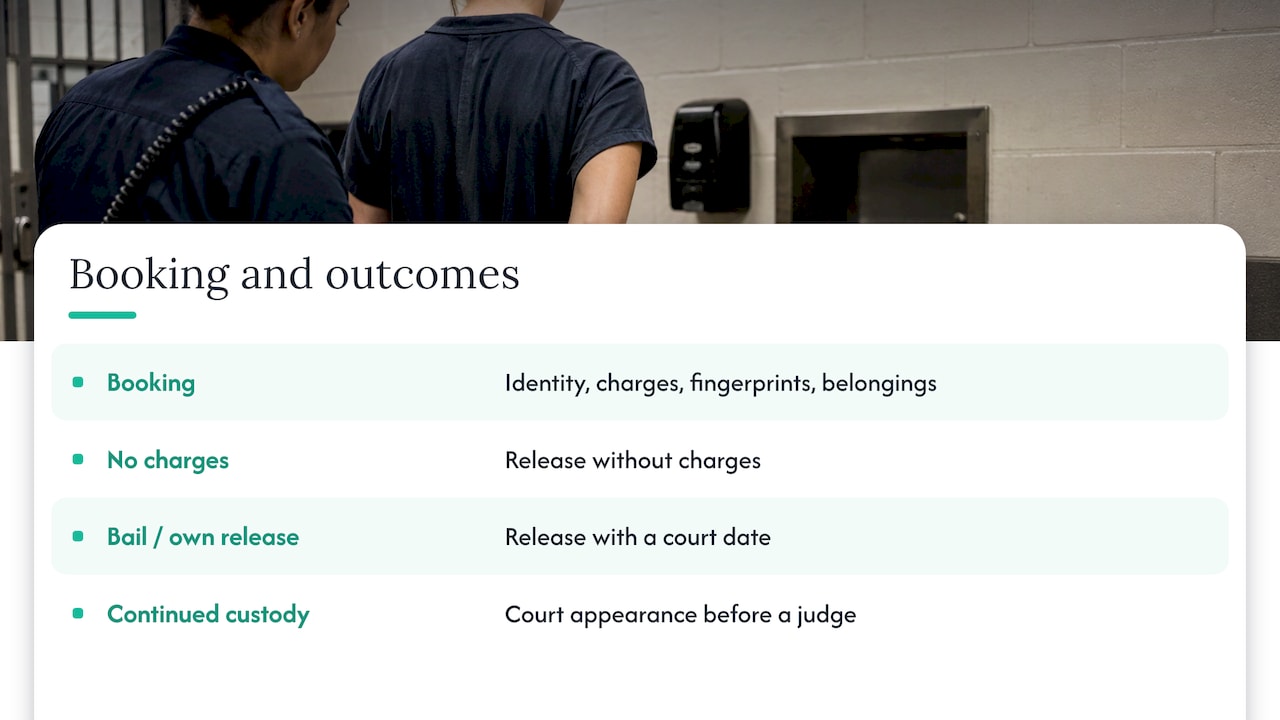
Which path applies depends on the charge, the county and the person’s history. Initial bail is often set before any judge is involved. Marin County’s Public Defender notes that the Sheriff’s Department sets initial bail before court and a judge may change it at the first appearance. If you want to see how amounts are decided, our guides on who sets bail in California and the bail schedule lay it out.
Step 1 for the family: find out where they are
Before you can do anything, you need to know which facility holds the person and under what booking information. Records can take time to appear after an arrest, so if the name does not show up right away, try again in a while. Our free inmate search is available to families, and our agents can help confirm custody and the bail amount by phone around the clock. For people who may have been moved to state prison, the Sacramento County District Attorney’s FAQ points to the state corrections locator.
Have these ready when you call:
- The person’s full legal name and date of birth
- The arresting city or agency, if known
- The booking number, if you have it
- The charges, if the jail has listed them
In Los Angeles County, jail and courthouse locations matter for logistics, so our Los Angeles courthouse directory and San Diego jail directory list the facilities.
Step 2: understand the 48-hour clock
A person who stays in custody cannot be left waiting indefinitely. The Lassen County Superior Court explains that a defendant in custody must be arraigned without unnecessary delay and no later than 48 hours after arrest, excluding Sundays and court holidays. If court is not in session when the period ends, the deadline moves to the next court session.
A worked example: someone arrested late Friday night may not see a judge until Monday, because the weekend days can stretch the practical timeline. That is the stretch when families feel most helpless, and when release before arraignment matters most. Marin County’s guide confirms that release before arraignment may be possible.
Some counties also have their own early-release processes. A 2026 California Law Revision Commission staff memo describes recent county-level pre-arraignment changes, including San Francisco’s 18-hour determination process for certain nonviolent, nonserious arrests and Los Angeles County release protocols. Because these programs differ by county and change, see our Los Angeles bail process guide before paying anything.
Step 3: choose how to seek release
There are two moments when release happens: before the first court date through bail, or at arraignment through a judge’s decision. At arraignment, California Courts’ Self-Help Guide lists the judge’s options: release on the person’s own recognizance, release under supervision, bail, or detention without bail until the case ends. Judges consider the offense, public safety and the likelihood the person will return to court.
Two terms worth knowing:
- Bail is money paid to secure release and assure future court appearances.
- Own recognizance (OR) release is a promise to appear, which may come with conditions.
The same Alameda County FAQ says the bail schedule is a guideline and that a lawyer may later ask for lower bail or OR release. Scheduled amounts also differ from county to county, since county superior courts generally write their own schedules.
When the bail amount is more than the family can put up in cash, a bail bond is the usual route. You pay a fee to a licensed bail agency, which posts the full amount with the jail or court. Our premium is 10% of the bail amount, and we offer flexible payment plans, including 2% bail bonds. Qualifying customers can also ask about financing. For the full sequence of paperwork and costs, read how to bail someone out of jail.
Step 4: sign the bond and what you are agreeing to
The person who signs a bail bond is legally responsible for it and its payment. That is usually a spouse, parent, relative or close friend, called the cosigner or indemnitor. In practice, this means three commitments:
- Pay the fee under the agreed terms.
- Make sure the defendant attends every court date.
- Tell the agent promptly if anything changes, such as a new address or a new arrest.
If you are signing for the first time, take the time to ask the agent about every line of the agreement. You are entitled to understand the costs, the timing and the eligibility rules before you commit. At Armstrong, you speak directly with licensed agents, not a call center, and we are open about costs, timing and eligibility. You can start the process by phone, in person or through our online bail bond application, then finish the signing with an agent. Questions about collateral come up often, and our page on no collateral bail bonds explains that option.
Step 5: how fast is release
Once a bond is posted, the jail still has to process the release. Our clients are often out within 30 minutes of bail processing, but jail workload and the facility decide the exact timing, and some releases take several hours. We explain the factors in how long after bail is posted someone is released and in our bail release time guide. Plan to be at or near the jail’s release area and have transportation ready.
Step 6: the first court date
The arraignment is usually the first court date. The Self-Help Guide says the judge tells the defendant the charges, their rights, and their right to appointed counsel if they cannot afford a lawyer. A person in custody who wants a public defender should tell the judge so: Alameda County’s Public Defender says eligibility is then assessed and an eligible person gets an attorney who explains the charges and process.
The point the family should hold onto: speak with a lawyer before pleading guilty or no contest. The Self-Help Guide warns that a plea can carry serious consequences, including immigration and employment effects. Nothing about getting out of jail should rush that decision.
For misdemeanors, the typical path continues with pretrial conferences and then trial if no agreement is reached. Felonies add more stages. Your defense attorney is the person to explain how your specific case will move.
After release: how to keep the bond and the case on track
Solano County’s Public Defender gives the basics for anyone out of custody: appear on time, avoid new trouble, and tell your lawyer quickly about any new citation or arrest. A missed court date or a new arrest can put the bond at risk, and the cosigner is the one affected financially. Our article on being arrested while on bail explains what a re-arrest means for the bond and the cosigner.
Practical habits that help:
- Put every court date in two phones and on a paper calendar.
- Confirm the courthouse, department and time the day before.
- Arrive early; security lines can be long.
- Keep copies of the bond paperwork and your agent’s number.
Fast reference: first 72 hours
| When | What to do | Who does it |
|---|---|---|
| Right after arrest | Stay calm, ask for an attorney, say nothing about the case | The arrested person |
| First hours | Locate the person, get the booking details and bail amount | Family |
| Before court | Decide on bail or a bond, sign the paperwork | Cosigner and bail agent |
| Within 48 hours (excluding Sundays and holidays) | Arraignment if still in custody | Judge, defendant, attorney |
| After release | Attend every date, report any new citation | Defendant and cosigner |
Getting your person home with Armstrong Bail Bonds
If the bail amount is set and you are ready to move, our agents are on the phone 24/7, with English and Spanish speakers. We write bonds for misdemeanor, felony and other charges across Southern California, and you can start with Los Angeles County bail bonds or San Diego County bail bonds. Payment plans are available for those who qualify.

If you are still working out what a bond is and who signs what, our page on what a bail bond is and how to get one is a good place to begin, and the Armstrong Bail Bonds home page has our contact options.
Our perspective
The worst hours of an arrest are the unknown ones. Families do not know where their person is, what the bail is, or whether the phone will be answered. We have been doing this since 1926, across four generations of one family, and the lesson has not changed: speed matters, but clarity matters just as much.
That is why you reach a licensed agent at any hour, not a call center. We tell you the premium, the timing and what the cosigner is responsible for before anyone signs. California sets bail pricing by law, so what we offer on top is a straight explanation and payment options that fit a family’s real budget.
Our advice to every family: get the facts first, say nothing about the case on the phone, and then call us. We will start the process with you remotely or in person, and we know the Southern California jails and courts well enough to keep it moving.
Jake
FAQ
How long can someone be held after an arrest in California?
A person who stays in custody must generally be arraigned within 48 hours of arrest, excluding Sundays and court holidays. If court is not in session when that period ends, the deadline extends to the next court session. Many people are released earlier, on bail or with a promise to appear.
Can my relative get out before seeing a judge?
Often yes. Depending on the charge and county, a person can be released without charges, released with a court date, or released after bail is posted. Bail is the route families can control, and our agents can tell you the amount and start the bond right away.
What should my loved one say to the police?
Official California guidance says to stay calm, follow directions, state clearly that they want to remain silent and want an attorney, and sign nothing without counsel. They should also avoid talking about the case on jail calls, which can be recorded.
What happens if bail is denied?
At arraignment a judge can release a person, set bail or order detention without bail until the case ends. A defense attorney can later ask for a lower bail or release on recognizance. Your attorney is the person to explain which applies to your case.
Who is responsible for the bond once it is signed?
The cosigner who signs the agreement is legally responsible for the bond and its payment. That includes making sure the defendant attends every court date and telling the agent about any new arrest or change in address.
Sources
- Stages of the Court Process, Solano County Public Defender
- PC 832 Volume 2, California POST
- What happens if I am arrested and taken into custody?, Los Angeles Superior Court
- What to Expect in a Criminal Case, Marin County Public Defender
- How can I find out where someone is incarcerated?, Sacramento County District Attorney
- Criminal, Lassen County Superior Court
- Staff Memorandum 2026-09, California Law Revision Commission
- The arraignment, California Courts Self-Help Guide
- FAQ, Alameda County Public Defender